
bordarretazos
Categoría: Uncategorized
marzo 11, 2019
«¿Cómo aproximarnos a la manera en que Google ‘articula un mundo’?» según Anna Munster
Habría que
1) investigar las «conjunciones entre Google y otras máquinas abstractas»: ¿estas conjunciones producen un endurecimiento o una fractura en la manera en que Google articula una imagen del mundo? (problemática que concierne a lo que Guattari llama una ecología generalizada que opera en un agenciamiento maquínico).
2) estar atentos a sentir, experimentar y diagnosticar «cómo y dónde las relaciones entre el motor de búsqueda de Google y, por ejemplo, los datos cartográficos pierden su precisión, liberando nuevas energías y conjunciones que nos permitan un nuevo diagrama de las redes» (perspectiva que corresponde a lo que Guattari llama una microecología, molecular y diagramática).
Aquí la argumentación completa:
«Guattari has suggested that to consider a living system only as a closed, autopoietic unity of inputs and outputs cut off from the developmental events of its entire genetic phylum would fail to account for its liveliness (1995: 39). And for Maturana and Varela ecosystemically autopoiesis is always organized and organizing in relation to both other autopoietic processes and a greater ecology of interactions (1988: 43 – 50). Autopoiesis entails collective activity and collectives always comprise a diverse ensemble of human, nonhuman, institutional, and technical agents. Niklas Luhmann also noted that a more generalized systems approach to autopoiesis might see nonliving systems using a general “ system-building ” principle of “ self-referential closure ” (2008: 84). Once we understand generative processes transversally, the distinction breaks down between technical systems as allopoietic (producing something apart from themselves; a factory producing a silicon chip, for instance) and living systems as autopoietic: “ Institutions and technical machines appear to be allopoietic, but when one considers them in the context of the machinic assemblages they constitute with human beings, they become ipso facto autopoietic. Thus we will view autopoiesis from the perspective of the ontogenesis and phlyogenesis proper to a mecanosphere superposed on the biosphere» (Guattari, 1995: 40).
It is at this level of a reinvigorated analysis of networked ecology that we need to apprehend the conjunctions and edges of Google ’ s world making. Both Google’s making, that is, of a searchable world and its cloaking of that world in data. To do this, we must come at Google from both ends — on the one hand from the viewpoint of what Guattari calls a generalized ecology, “ to comprehend the interactions between ecosystems, the mecanosphere and the social and individual Universes of reference” (Guattari, 2008: 29); and on the other hand from the molecular, diagrammatic perspective of microecologies. The former will search out the conjunctions between Google and other abstract machines, asking whether these conjunctions lead to a hardening or cracking of the seamless surface of googlization. The latter will involve feeling out how and where, as with Autoscopia , the relations between search engine and the cartographic loosen up, releasing new energies and conjunctions that allow for a new diagram of networks.»
Anna Munster, «Welcome to Google Earth» en An Aesthesia of Networks, pág. 50.
marzo 11, 2019
«En un agenciamiento maquínico, las instituciones y las máquinas técnicas» a diferencia de lo que creían Varela y Maturana, «son también autopoiéticas»
«Guattari has suggested that to consider a living system only as a closed, autopoietic unity of inputs and outputs cut off from the developmental events of its entire genetic phylum would fail to account for its liveliness (1995: 39). And for Maturana and Varela ecosystemically autopoiesis is always organized and organizing in relation to both other autopoietic processes and a greater ecology of interactions (1988: 43 – 50). Autopoiesis entails collective activity and collectives always comprise a diverse ensemble of human, nonhuman, institutional, and technical agents. Niklas Luhmann also noted that a more generalized systems approach to autopoiesis might see nonliving systems using a general “ system-building ” principle of “ self-referential closure ” (2008: 84). Once we understand generative processes transversally, the distinction breaks down between technical systems as allopoietic (producing something apart from themselves; a factory producing a silicon chip, for instance) and living systems as autopoietic: «Institutions and technical machines appear to be allopoietic, but when one considers them in the context of the machinic assemblages they constitute with human beings, they become ipso facto autopoietic. Thus we will view autopoiesis from the perspective of the ontogenesis and phlyogenesis proper to a mecanosphere superposed on the biosphere» (Guattari, 1995: 40).»
Guattari, citado por Anna Munster en An Aesthesia of Networks, pág. 50.
marzo 5, 2019
Sobre Kafka y su máquina célibe
«Si tratamos de resumir la naturaleza de esta máquina artista según Kafka, debemos decir: es una máquina célibe, la única máquina célibe, y por ello mismo tanto más conectada a un campo social de conexiones múltiples. Precisamente por no tener familia, ni conyugabilidad, el célibe por sí solo es más social, social-peligroso, social-traidor, y colectivo. («Estamos fuera de la ley, nadie lo sabe, y sin embargo todo el mundo nos trata como si lo supiera.») Es que el secreto del célibe es este: su producción de cantidades intensivas, las más bajas como las de las ‘cochinas cartas’, y las más altas como las de la obra ilimitada; esta producción de cantidades intensivas, el célibe la realiza en el cuerpo social, en el campo social mismo. Un mismo y único proceso. El más alto deseo desea al mismo tiempo la soledad y el estar conectado a todas las máquinas de deseo. Una máquina tanto más social y colectiva cuanto que es solitaria, célibe, y que, al trazar la línea de fuga, equivale necesariamente ella sola a toda una comunidad cuyas condiciones no están dadas todavía en la actualidad: ésa es la definición objetiva de la máquina de expresión que, como hemos visto, remite al estado real de una literatura menor donde ya no hay ‘problema individual’. Producción de cantidades intensivas en el cuerpo social, proliferación y precipitación de series, conexiones polivalentes y colectivas inducidas por el agente célibe: no hay otra definición»
Deleuze y Guattari, Kafka. Por una literatura menor, pág. 104.
enero 28, 2019
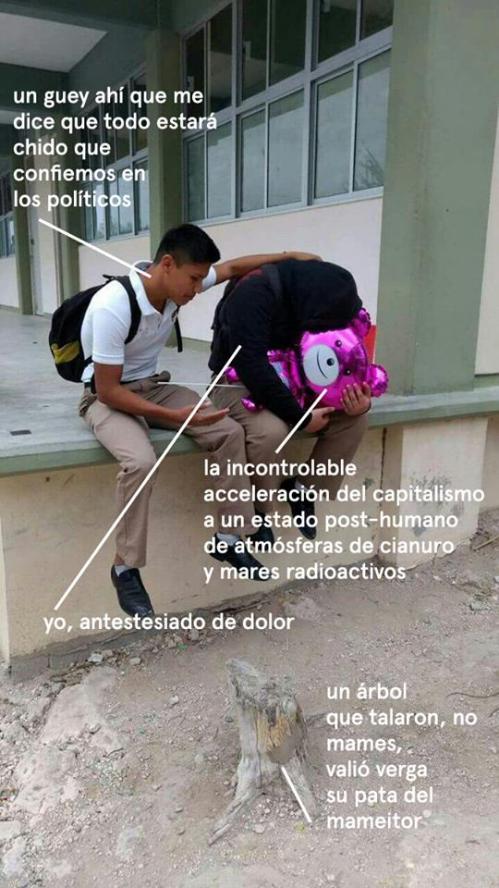
El cruel optimismo de la vida académica
“It will get better,” we assure students who struggle to learn. We are so definite. Were we more honest, we would say, “it might get better,” “perhaps,” “maybe,” or, simply, “we don’t know.” Instead, we say, “there are no guarantees, but.” And that “but,” that barely uttered, barely hearable “but” carries so much weight. Everyone wants to hear the “but.” Everyone invested in the academy is always hearing the “but.” We are a community organized around “but.” Lauren Berlant calls this “cruel optimism.”
Keguro Macharia, «On Quitting» en The New Inquiry: https://thenewinquiry.com/on-quitting/
 bordarretazos