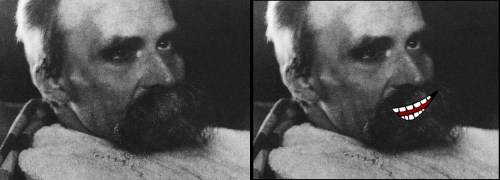
Por amor a Nietzsche
![]()
«El legislador es, en todos los aspectos, un hombre extraordinario (…). Si debe serlo por su genio, no lo es menos por su función. No es magistratura, no es soberanía. Esta función, que constituye la República, no entra en su constitución; es una función particular y superior que no tiene nada de común con el imperio humano.
(…)
Así, se encuentra a la vez en la obra de la legislación dos cosas que parecen incompatibles: una empresa por encima de la fuerza humana y, para ejecutarla, una autoridad que no es nada.»
Rousseau, Jean-Jacques, «Capítulo VII. Del legislador» en El contrato social, trad. Consuelo Bergés, Madrid: Editorial Gredos, 2011, pág. 291.
«El caminante. Quien en alguna medida ha alcanzado la libertad de la razón no puede sentirse sobre la tierra más que como un viajero, aunque no como alguien que viaja hacia una meta final: pues no la hay. Pero sin duda quiere observar y tener los ojos abiertos para todo lo que propiamente hablando ocurre en el mundo; por eso no puede prender su corazón demasiado firmemente de nada singular; en él mismo ha de haber algo de vagabundo que halle su placer en el cambio y la transitoriedad. Por supuesto, tal hombre pasará malas noches, en las que esté cansado y encuentre cerrada la puerta de la ciudad que debía ofrecerle descanso; quizá además, como en Oriente, el desierto llegue hasta la puerta, las fieras aúllen tan pronto más lejos como más cerca, se levante un fuerte viento, los ladrones le roben sus acémilas. Entonces la noche pavorosa desciende sobre él como un segundo desierto en el desierto y su corazón se cansa de caminar.
Leer el resto de esta entrada »«Loosing love
is like a window in your heart
everybody sees you’re blown apart
everybody sees the wind blow»
“Cuando Maimón se pregunta: “ ¿Soy kantiano? ¿Soy antikantiano?”, ¿no hay allí una pregunta de perverso? Es todo el humor del perverso: obedecer con tanto celo que al final la ley se ve invertida puesto que termina por favorecer lo que se suponía prohibir. De allí el gran interés de Deleuze por el masoquismo, y especialmente por su “espíritu jurídico”. Precisamente, la denegación en Masoch — tan importante para la perversión en general— “no consiste en negar y ni siquiera en destruir, sino mucho más que eso, consiste en impugnar la legitimidad de lo que es, en someter lo que es a una suerte de suspensión, de neutralización, aptas para abrir ante nosotros, más allá de lo dado, un nuevo horizonte no dado». ¿La perversión como crítica de los fundamentos, en el nombre mismo de la búsqueda más celosa de un fundamento?
Leer el resto de esta entrada »“The notion of continuity has roots not only in the history of philosophy but also in the history of mathematics. One might view Greek mathematics, in particular geometry, as having two poles. One pole, represented by Euclid, deals with the properties of static geometrical figures. The other pole, represented by Archimedes, concerns the construction of actual geometric figures. To apply the terms from the discussion of the history of philosophy, Euclid pursues a geometry predicated on discontinuity, while Archimedes pursues a geometry predicated on continuity. That is, Euclid is concerned about the universal, intelligible components of geometric figures, while Archimedes is concerned about the processes by which actual, different geometric figures might be generated. More important, however, is the way in which the Euclidean geometry of stable objects came not only to dominate geometry but also to be seen as the model for mathematics. Ultimately, this privileging of discontinuity expresses itself in mathematics as the preference for the discrete over the continuous. From the perspective of mathematics, the discrete has the trernendous advantage of making things countable and thereby subject to algebraic analysis. The continuous, in contrast to the discrete, is messy, slippery, and unstable. One doesn’t extract timeless truths from the continuous; one intervenes strategically. The discrete is axiomatic; the continuous is problematic. The difficulty that Deleuze sees with the triumph of the discrete in mathernatics is that life is not discrete. Life presents constant and continuous variability. It is for precisely this reason that Deleuze deploys the resources provided by calculus. Calculus thinks the continuous and variable without making it discrete. Calculus allows one to think without recourse to discontinuity. There is no immutable, intelligible component that the object of analysis more or less conforms to. There is only constant variability that tends toward infinity (…)”
The same battle between continuity and discontinuity is “played out in the history of mathematics, first in the distinction between axiomatic and problematic geometry and more recently in the attempt to ground calculus in set theory. If we recast this battle as a response to the question, What is a thing?, we discoyer that the same tension between stability and change is at work. The preferences for axiomatic geometry and for grounding calculus in set theory both reflect the idea that mathematics properly deals
with the discrete, the quantifiable, that for which we can produce an axiom. Thus, the «thing» in mathematics is the countable. Deleuze’s use of mathematics, particularly his use of calculus in Difference and Repetition, shows that he remains interested in that «lost» object of mathematics, the intensive, continuous, abstract «thing.» The reasons behind the choice of calculus in that book are still operative in A Thousand Plateaus. These reasons become explicit in Deleuze and Guattari’s distinction between royal science and minor or nomad science. «Royal science is inseparable from a ‘hylomorphic’
model implying both a form that organizes matter and a matter pre-pared for the form» (TP 369). Royal science is designed to work in concert with the state and deals in discrete and ideal essences, such as circles. In contrast to this, nomad science is inseparable from a «hylozoic» model in which matter is self-organizing and generates its own form. Nomad science is not interested in circles as an ideal type, but it is interested in «roundness,» the continuous curve, which sometimes appears as a circle. But, for nomad science the circle is not what roundness necessarily or even ideally tends toward.”
Atkins, Brent, Deleuze and Guattari’s A Thousand Plateaus, Edinburgh: Edinburgh University Press, 2015.

«Señor Director del difundido diario:
Considerando los chistes dudosos (¿Es chiste o no es chiste?) como un género superior, de más calidad que el chiste cierto y por ello más escaso de ejemplares, como lo comprobará el que se dedica a inaugurar una colecta de ellos, propongo crear la Sección de esta especie, de la risa en duda.
Ofrezco para ella estos pocos representantes del no-en-seguida-chiste, cuyo honor y signo de verdadera calidad finca en que le sigue una pausa de la humana duda. Hecha exclusión de lo que es indigno de duda en humorismo –las oratorias inaugurativas y aniversarias– verá usted que pocos chistes de este alto tipo se pueden recolectar:
–Era tan feo, que aun los hombres más feos que él no lo eran tanto.
–Era tan obstinado y de mal gusto que hasta un instante antes de morir, vivía.
–Al ladrón, bajo la cama: –¡Pero hombre! ¡Se ha puesto usted la cama del revés!
–El feo, recién presentado, le dice a la dama: –Señora: soy feo, es muy cierto; pero no es culpa mía; se me machacó tanto el ser previsor y disciplinado, que nunca dejara nada para el día de mañana, que no pude apartarme de esta norma inveterada. Soy feo, es cierto, pero qué queréis, ¡no he podido dejarlo para mañana!
–Disparaba tan ligero y tanto, que de repente tuvo el susto de si no había dado la vuelta al mundo y estaba a un centímetro de embestir su espalda.
–Fueron tantos los que faltaron que si falta uno más no cabe.
En fin, quiero explicarle que si no he cumplido últimamente con mi compromiso de colaboración, es porque me encuentro desde hace algún tiempo en la tarea de clasificar (o clarificar) la Realidad, o por lo menos de ordenar ciertas categorías»
Fernández, Macedonio, «Del bobo de Buenos Aires» de Papeles de Recién venido.
«State philosophy’ is another name for the representational thinking that has dominated Western metaphysics since Plato, but has suffered an at least momentary setback during the last quarter century at the hands or Jacques Derrida, Michel Foucault and poststructuralist theory generally. As described by Deleuze, State Philosophy is grounded on a double identity: of the thinking subject, and of the concepts it creates and to which it lends its own presumed attributes of sameness and constancy. The subject, its concepts, and the «external» objects to which the concepts are applied have a shared, internal essence: the self-resemblance at the basis of identity. Representational thought is analogical; its concern is to establish a correspondence between these symmetrically structured domains. The faculty of judgment serves as the police force of analogy, assuring that each of the three terms is honestly itself, and that the proper correspondences obtain. In thought its end is truth, in action justice. The weapons it wields in pursuit of these are limitative distribution (the determination of the exclusive set of properties possessed by each term in contradistinction to the others: logos, law) and hierarchical ranking (the measurement of the degree of perfection or a term’s self-resemblance in relation to a supreme standard, Man, God, or Gold: value, morality). The modus operandi is negation: x=x=not y. Identity, resemblance, truth, justice, and negation. The rational foundation for order. The established order, of course: philosophers have traditionally been employers of the State. The collusion between philosophy and the State was most explicitly enacted in the first decade of the nineteenth century with the foundation of the University or Berlin, which was to become the model for higher learning throughout Europe and the U.S. The goal laid out by Wilhelm von Humboldt (based on proposals by Fichte and Schleiermacher) was the “spiritual and moral training of the nation,” to be achieved by “deriving everything from an original principle” (truth), by “relating everything to an ideal” (justice), and by “unifying this principle and this ideal in a single Idea” (the State). The end product would be “a fully legitimated subject of knowledge and society” –each mind analogously organized mini-State morally unified in the supermind of the State. Prussian mind-meld. Even more insidious than today’s well-known practical cooperation between the university and government (the burgeoning military funding of research) was its philosophical role in propagating the form of representational thinking itself that ‘properly spiritual absolute State’ endlessly reproduced and disseminated at every level of the social fabric (nationalism and good citizenship). More insidious than its institution-based propagation is the State-form’s ability to propagate itself without centrally directed inculcation (liberalism and good citizenship). Still more insidious is the process presiding over our present plight, in which the moral and philosophical foundations of national and personal identity have crumbled, making a mockery of the State-form –but the world keeps right on going as if they hadn’t (neoconservatism and cynical greed).”
Massumi, Brian, A user’s guide to Capitalism and Schizopphrenia. Deviations from deleuze and Guattari, Swerve Editions/MIT, 1996, p. 4.
«las cosas, las personas y los nombres son como cajas, de las que se saca algo que tiene otra forma por completo distinta, algo de distinta naturaleza, contenido desmesurado»
Blog de literatura de Martín Cristal. Diario de lectura y otros textos
Just another WordPress.com weblog
Apuntes para picotear
Recovering the past, creating the future
Revista latinoamericana de ciencia ficción
En defensa de la vida y un habitar digno
Learn easily Greek via the linguistic relationships and the roots of the English words.
SOBRE CRÍTICA. VISUALIDAD. ESCRITURA. POEMA: ENCUENTROS; Un objeto, una cosa. Nos sentamos frente a él. Lo interrogamos: él nos dice algo. El desmontaje es en tiempo ahora: Una crítica de voces. Una crítica de imágenes. Recuerdos. Flashazos.
ARCHIVO DE PROYECTOS
Sobre la administración responsable y sostenible del planeta
arte, sociología, cuerpo vibrátil
Consejos para promover la biodiversidad en las ciudades
memoria[ndo]
ArqueoBlog — Trasladado a arqueoblog.eu
Falsa antología mexiquense
Siguiendo el laberinto de nuestro deseo